

Since its debut in 1985, the BMW M3 has evolved through six generations, combining technological innovation, high performance, and a career in motorsports that became one of the sport's most iconic BMW.
There are cars that stand out for their benefits and others that manage to become a reference in an entire generation. The BMW M3 belongs to the latter category. Four decades after its presentation, its history brings together some of the most important chapters of BMW M, both inside and outside of the circuits.
Although the BMW M1 was the first car developed by BMW M GmbH, the M3 was ended by defining the identity sports division. His combination of agility, precision, strength, and aesthetics unmistakable established a formula that has evolved without losing its essence.
The 40 years of the BMW M3 also represent the transformation of a car designed for competition in a family of high-performance sports, able to adapt to new technologies and needs without giving up the pleasure of driving.
BMW M3 E30 (1985): the birth of a legend
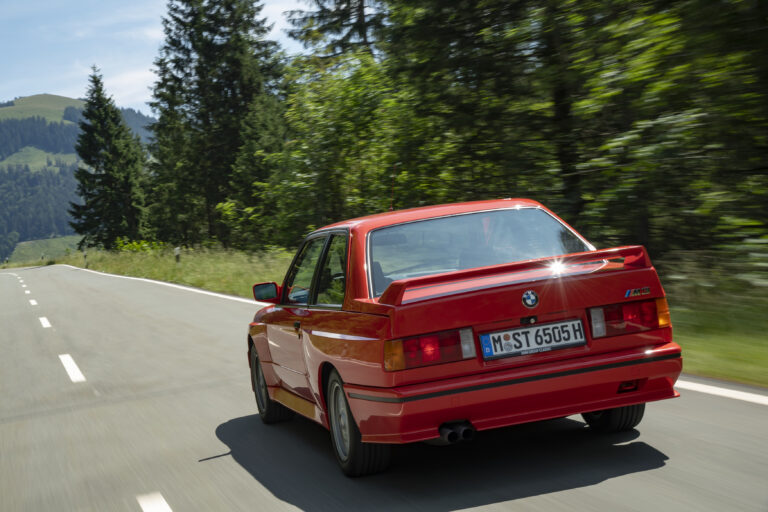
The story began at the International motor show in Frankfurt, 1985, where BMW introduced a coupé soon to demonstrate that their true potential was far beyond the roads.
The first BMW M3, known as the E30, incorporated an engine of four cylinders and 2.3 liters, with the technology of four-valve and a power of 200 hp. Its approximate weight of 1,200 kilograms allowed him to accelerate from 0 to 100 km/h in 6.7 seconds and reach a top speed of 235 km/h.
Your body two-door, flared wheel arches and aerodynamic specific response to a philosophy where each element had a function.
However, it was in the motorsport where the M3 E30 built much of his reputation. His victories in the DTM, the World Touring car Championship and the 24 Hours of Nürburgring consolidated him as one of the touring car racing's most successful of its time.
That first generation not only opened a family of sports. It also established a relationship between the production vehicles and racing that continues to form part of the DNA of BMW M.
BMW M3 E36 (1992): further refinement and six cylinders
With the arrival of the second generation in 1992, the BMW M3 started a new stage. The sporty character remained intact, but its design adopted a more elegant look and unobtrusive.
The most important change was under the hood. For the first time, the M3 incorporated a six-cylinder engine in-line, a configuration that would end up becoming one of the signs of identity of the model.
The range also grew. To the versions of the coupé and roadster will be joined by a sedan body four door, expanding the possibilities of those who sought to combine high performance with maximum versatility.
In 1996 came another innovation is important to the transmission sequential M, known as the SMG, which introduced a new way of experiencing the gear changes in a sporty BMW.
The M3 E36 showed that the performance and refinement could coexist, opening the way to an interpretation of the most complete of the concept M.
BMW M3 E46 (2000): precision, character and the legendary CSL
The turn of the millennium brought with it one of the generations most remembered by the fans. Presented in the year 2000, the BMW M3 E46 recovered an image more muscular, with flared wheel arches, a hood, distinctive design and four exhaust outlets.
Your engine inline six-cylinder and 3.2-litre developing 343 hp, offering a response that reinforce the sporty character of the model.
But one of the chapters featured in this generation came with the BMW M3 CSL, a special edition that took the philosophy of lightweight construction to a new level.
With 360 hp and a weight reduction compared with the conventional model, the M3 CSL accelerated from 0 to 100 km/h in 4.9 seconds. His focus on accuracy, aerodynamics and weight-to-strength to become one of the versions most admired of the history of the M3.
In parallel, the BMW M3 GTR wrote his own history in racing, with success in the American Le Mans Series, and two victories at the 24 Hours of Nürburgring.
BMW M3 E90, E92 and E93 (2007): the was V8 engine
The fourth generation marked a major shift in the evolution mechanics of the BMW M3. In 2007, the traditional six-cylinder gave way to a V8 naturally aspirated 4.0-liter, developed under the concept of the high-revving BMW M.
With a power of 420 hp, the BMW M3 Coupe could accelerate from 0 to 100 km/h in 4.8 seconds, offering a driving experience defined by the response of the accelerator, and the characteristic sound of its engine.
This generation also maintained a close relationship with the motor racing.
In 2012, BMW returned to the DTM after two decades of absence. The return was extraordinary: Bruno Spengler won the drivers 'championship, BMW Team Schnitzer won the title for the equipment and the brand won the constructors' championship.
The BMW M3 DTM reaffirmed a tradition started with the E30: move the competitive spirit of BMW M to the most demanding scenarios.
BMW M3 F80 (2014): the arrival of the technology M TwinPower Turbo
The fifth generation, introduced in 2014, introduced a transformation that would shape the future of the model.
For the first time, the designation BMW M3 was reserved exclusively for the body four-door sedan, while the variants coupé and convertible became part of the family BMW M4.
Also came a change in the mechanical key. The atmospheric V8 was replaced by a new engine six-cylinder in-line with technology M TwinPower Turbo.
The boost to increase the power and torque, while at the same time decreased approximately 25% in the fuel consumption and emissions over its predecessor, according to the data of BMW.
In his version of the Competition, the BMW M3 Sedan reached 450 hp and was able to accelerate from 0 to 100 km/h in 4.0 seconds.
The F80 represented a new interpretation of the high-performance, where the efficiency and the technology began to play an increasingly important role.
BMW M3 G80 and G81 (2020): all-wheel drive and a new body-Touring
The sixth generation of the BMW M3 arrived in 2020 with a proposal that combined the tradition mechanics of BMW M with new technological solutions.
The six-cylinder engine in the line continued as the protagonist, but the range incorporated significant innovations. In 2021, the system of four-wheel drive M xDrive came for the first time the BMW M3, expanding your possibilities for traction and performance.
A year after that, he was one of the models most anticipated by enthusiasts: the BMW M3 Touring.
The body family allowed to combine the performance characteristics of the M3 with more cargo space and versatility, opening a new chapter in the history of the model.
The sixth generation also gave rise to the BMW M3 CS, a limited edition with an acceleration from 0 to 100 km/h in just 3.4 seconds and a top speed electronically limited to 302 km/h.
These figures reflect the technological distance traveled since the first M3 in 1985, without abandoning the principles that gave rise to the model.
40 years of the BMW M3: a history that continues to evolve
Of the 200 hp of the first BMW M3 E30 to the benefits of the contemporary versions, the evolution of the model allows us to understand the four decades of technological development and sports.
Each generation has responded to the demands of his time. The E30 established his reputation in the circuits; the E36 introduced a more sophisticated; the E46 perfected the formula with the CSL, the E90 took the concept to the era of V8; the F80 joined the boost and the G80 opened new possibilities with the all-wheel-drive and body-Touring.
But beyond the numbers, the true legacy of the BMW M3 is in having maintained a recognizable identity for six generations.
Forty years after its presentation in Frankfurt, the M3 continues to be a reference among high-performance sports and one of the best examples of how the experience of BMW in motorsport-you can move to a car designed to be enjoyed also on the road.
Source: BMW Group