

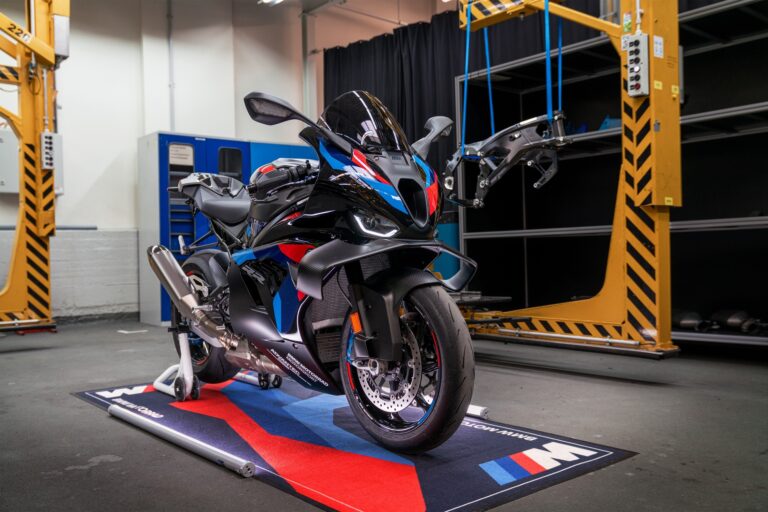
Munich. BMW Motorrad presents the third generation of his frame M Motorsport, an evolution that reduces the weight, optimizes stiffness and moves the advances developed in the international circuits to the BMW M 1000 RR production.
The new frame BMW M 1000 RR represents an important step in the technological evolution of the superbike German. From model year 2027, BMW Motorrad will incorporate serial the third generation of the rack M Motorsport, developed from the experience gained in the international competitions.
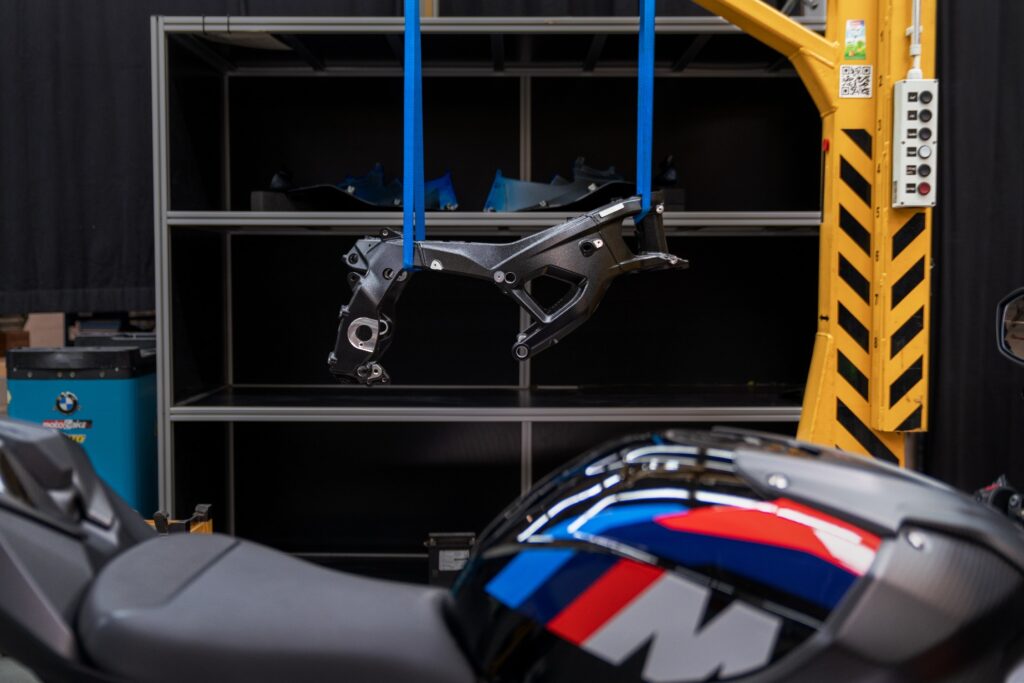
This new structure of aluminum is approximately 1.3 kg lighter than its predecessor and features an optimized distribution of the stiffness and flexibility. Your goal is to improve the precision of driving, favor the contact of the tires with the road and provide a behavior more predictable in demanding conditions.
The innovation also reflects the ability of BMW Motorrad to integrate the digital development, advanced processes of smelting and the manufacture of precision in a motorcycle intended for both the road and the circuits.
New rack BMW M 1000 RR: less weight and higher precision
One of the main developments of this third generation is the reduction of about 1.3 kilograms relation to the frame above.
Although it may seem a small difference, the decrease of weight in a structural component of these features contributes to improve the agility of the motorcycle, especially during quick changes of direction and the maneuvers that require an immediate response.
However, the true technological development goes beyond the weight.
BMW Motorrad has managed to reduce up to 30%, the wall thickness of certain areas of the frame, allowing you to adjust specific manner to their characteristics of stiffness and flex.
The result is a structure designed to respond differently to the forces acting on the motorcycle during sporty driving.
A balance between rigidity and flexibility
Riding a motorcycle on a high-performance, rack-an extremely rigid is not always the ideal solution.
During the step-by-turn, especially when the motorcycle reaches tilt angles high, the ability of the structure to flex laterally in a controlled way can help to maintain a more constant between the tires and the asphalt.
Precisely, this is one of the key features of the new frame M Motorsport.
Its lateral flexibility complements the work of the suspension to absorb certain irregularities of the surface, favoring a more clear for the pilot and a more even wear of the tires.
At the same time, the structure retains a high longitudinal stiffness, which is indispensable to transmit accurately the forces generated during braking and acceleration.
This combination seeks to provide a motorcycle more communicative and predictable, even when driving close to its limits dynamic.
Technology developed in international competitions
The evolution of the rack M Motorsport is a result of the close relationship between the sports activities of BMW Motorrad and the development of their production bikes.
The knowledge gained by the official teams, and the teams of clients that compete internationally to assess technical solutions under conditions that are particularly demanding.
In this environment, aspects such as the stability, the accuracy of address, the response of the chassis and the traction they are crucial for the performance.
The third generation of the frame takes advantage of this experience to move progress of engineering at BMW M TO 1000 RR, which will come to the customers in 2027.
Sven Blusch, director of BMW Motorrad Motorsport, he stressed that the development combines a lightweight construction with features of rigidity and bending adjusted carefully, laying the groundwork for to get a precise behavior of the chassis and a high level of grip.
It also stressed the integration of the facilities of Munich, Landshut, lower bavaria and Berlin, whose collaboration will allow us to transform the experience of racing in components intended for series production.
The digital simulation of the precision manufacturing
The creation of the new frame, BMW M 1000 RR requires an industrial process involving three specialized facilities of BMW Group in Germany.
Each one plays a specific role, from the design and validation of digital until the casting of the components and the final assembly.
Munich: engineering, simulation and development
The process begins in the centre of the development of BMW Motorrad in Munich, where engineers define digitally the geometry of the frame, the thickness of its walls and the distribution of the stiffness.
Through computer simulations, tests on test benches and dynamic assessments, we analyze the structural characteristics before approving the design for manufacturing.
This method allows us to anticipate the behavior of the components and optimize its geometry without relying exclusively on physical prototypes.
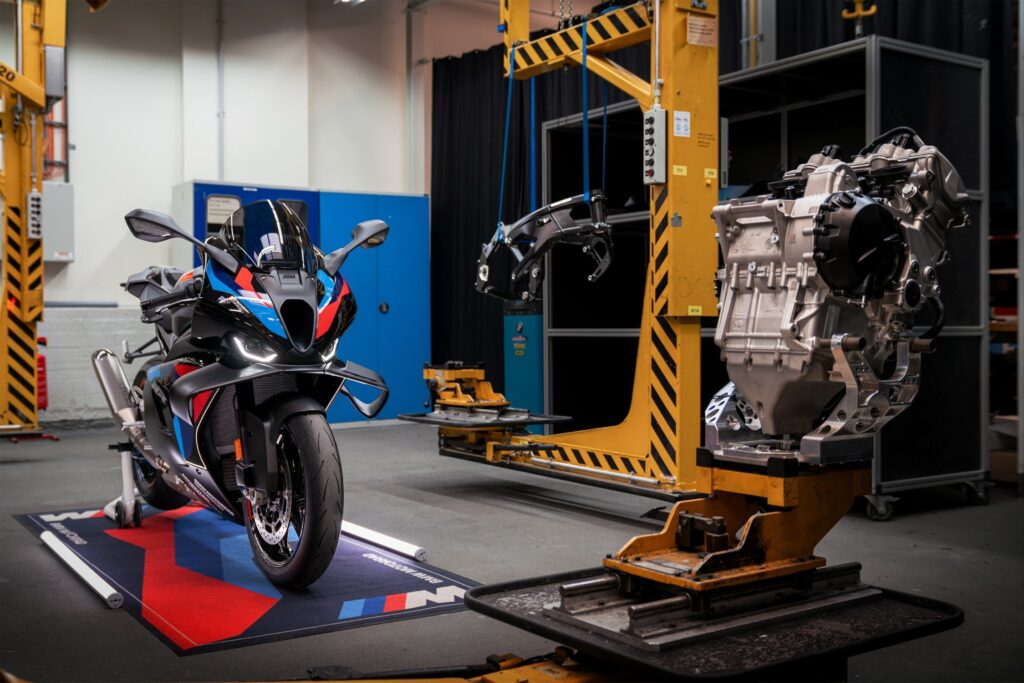
Once validated, the development, the digital information is used to fabricate the four main parts that make up the frame: the steering head, the side sections left and right, and the rear section.
Landshut: aluminum thin-walled
The next stage develops in the plant of the BMW Group in Landshut, specializing in lightweight components and advanced processes of casting.
Are manufactured here for the four structural parts using a casting process of aluminum at low pressure.
This technique allows you to enter the molten metal into molds in a controlled way, reducing the turbulence and the possible inclusions of air that could compromise the internal quality of the material.
To achieve complex geometries and thin walls, which requires the design, we used males temporary of quartz sand that form the internal cavities of the parts.
Even the manufacture of these elements is studied through digital simulations, capable of analyzing the behavior of the mixture of sand and air, compaction and curing process.
After casting, the components pass through various quality controls, including inspection by X-rays, thickness measurements and verifications dimensional coordinate.
These tests allow you to check that each part meets with the requirements laid down before continuing to the next phase of production.
Berlin: assembly and final finishing
The BMW Group in Berlin, the main production facility of BMW Motorrad, is responsible for converting the four pieces of aluminum in a complete frame.
The components are positioned carefully, and is joined together by TIG welding, a procedure that allows you to perform joins of high precision.
Subsequently, the structure receives a coating cathodic dip that provides protection against corrosion, even in the internal cavities.
The process continues with the final machining of the functional surfaces and mounting points, until you reach the required dimensions.
A final inspection using coordinate measuring verify the dimensional accuracy of the set before authorizing their installation in the BMW M 1000 RR.
In this way, BMW Motorrad integrates different manufacturing technologies to produce a component that must meet exacting standards of quality, strength and dynamic behavior.
The BMW M 1000 RR wins presence in Latin america
The addition of the new frame coincides with a period of commercial growth for the BMW M 1000 RR in Latin america.
According to BMW Motorrad, during the first half of 2026 the sales of this model in the region increased by 150% compared with the same period of 2025.
This result reflects the growing interest in motorcycles and high performance, especially those that incorporate technologies developed in the field of the competition.
For users in Latin america, the evolution of the frame represents an improvement-oriented to achieve greater accuracy when entering corners, for a more defined in the chassis, and a sense of control more consistent during sporty driving.
At the same time, the new platform will continue to serve as the technology basis for the equipment of BMW Motorrad Motorsport that are involved in various international championships.
BMW M 1000 RR 2027: the competition as a laboratory of innovation
The arrival of the third generation of the rack M Motorsport demonstrates that the evolution of a superbike depends not only increase the engine power or incorporate new electronic systems.
Structural engineering continues to be one of the key factors to transform the performance of a motorcycle.
To reduce the weight, control the flexibility and maintain the stiffness where it is needed are challenges that require a deep knowledge of the materials, the dynamic vehicular and manufacturing processes.
With the new frame, BMW M 1000 RR, the German brand seeks to refine precisely these aspects, taking advantage of the knowledge acquired in the international competitions.
From 2027, this technology will form part of the standard equipment of the BMW M 1000 RR, bringing still more engineering developed in the circuit riders looking for a sporty driving experience at a high level.
An evolution which confirms that, for BMW Motorrad, the competition is not only a stage on which to demonstrate the performance of their motorcycles, but also a laboratory to develop the technologies of the future.
Source: BMW Group