

Munich/Berlin. The Maurizio Cattelan NIGHT already has a date of your arrival to Berlin. The Neue Nationalgalerie presents the first major solo exhibition of the Italian artist in Germany, a proposal designed especially for the iconic building designed by Ludwig Mies van der Rohe. The exhibition, which brings together some of the most recognized works of Cattelan, with new installations created specifically for this space.
The exhibition can be visited from September 10, 2026 to march 7, 2027, and is part of the Award Nationalgalerie 2026, one of the most important recognitions of Germany within the contemporary art. BMW is back to participating as a partner of this award, a collaboration that has been in place since 2006.
Maurizio Cattelan NIGHT: art, memory, and power
Under the title of NIGHT, Maurizio Cattelan proposes a reflection on the uncertainty, memory, identity, faith, and power structures. The exhibition uses the night as a metaphor for those moments in which the certainties begin to disappear and the perception of reality becomes more ambiguous.
The exhibition has been curated by Lisa Botti, curator of the Neue Nationalgalerie, and Klaus Biesenbach, director of the institute, in close collaboration with the artist himself.
For Cattelan, the night not only represents the absence of light. It is a state in which that which usually seems obvious acquires new meanings. From this perspective, his works play with images and figures known to alter its interpretation, and generate a constant tension between irony, vulnerability and ambiguity.
The architecture of the Neue Nationalgalerie acquired in addition to a starring role. The building of Mies van der Rohe not only works as a stage, but as an integral part of the exhibition. The works engage in dialogue directly with their huge expanses of glass, an open structure and its relationship with the urban space of Berlin.
A temporary church in the heart of Berlin
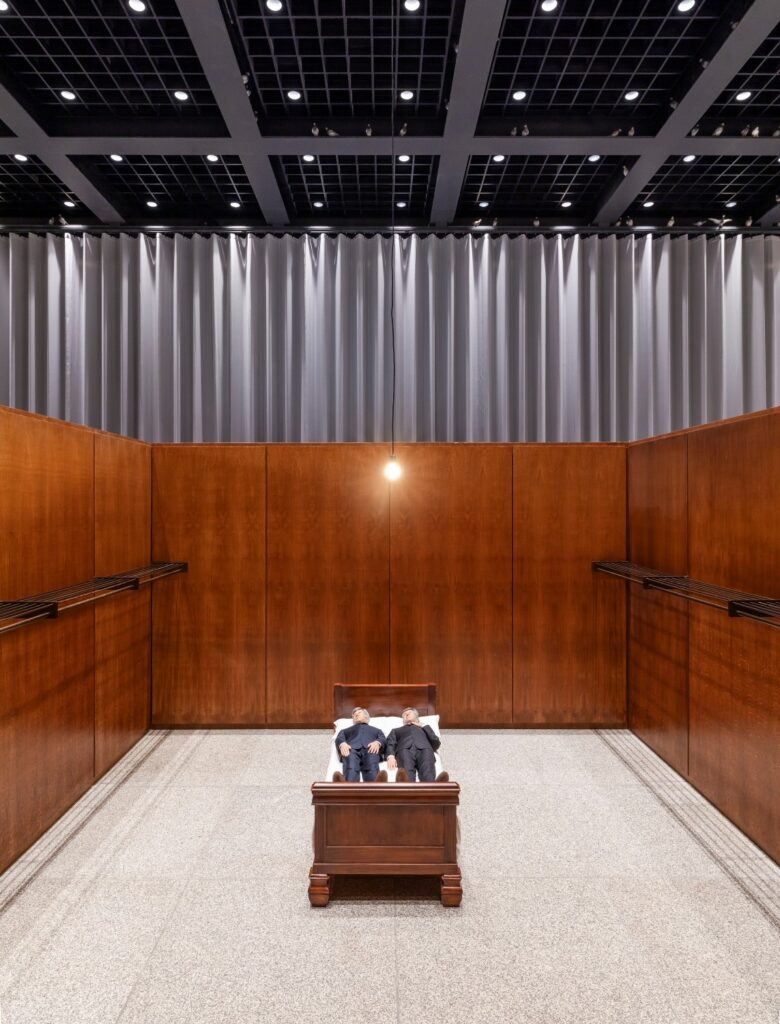
One of the most eye-catching of Maurizio Cattelan NIGHT is the transformation of the temporary crystal room of the Neue Nationalgalerie. The space takes on the appearance of a church, creating an environment in which these works may address concepts related to the devotion, death, memory, and human frailty.
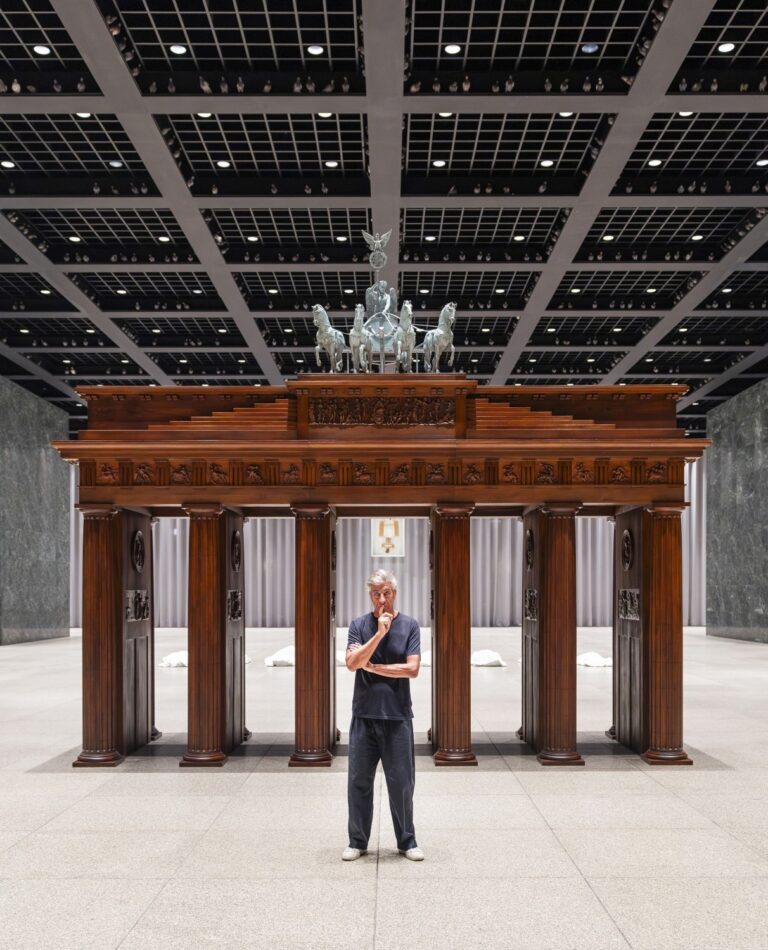
The exhibition begins with “Purgatory” (2026), a new work that introduces a scaled-down version of the Brandenburg Gate inside the museum. Separated from their urban context, as usual, monument changes meaning and becomes a symbol of transition, reflection, and historical memory.
In the center of the room are “Him” (2001) and “Dawn” (2007). The first depicts a male figure kneeling in prayer, while the second presents a female figure inside a shipping crate. Together, the two works establish a visual axis that juxtaposes different forms of vulnerability and devotion.
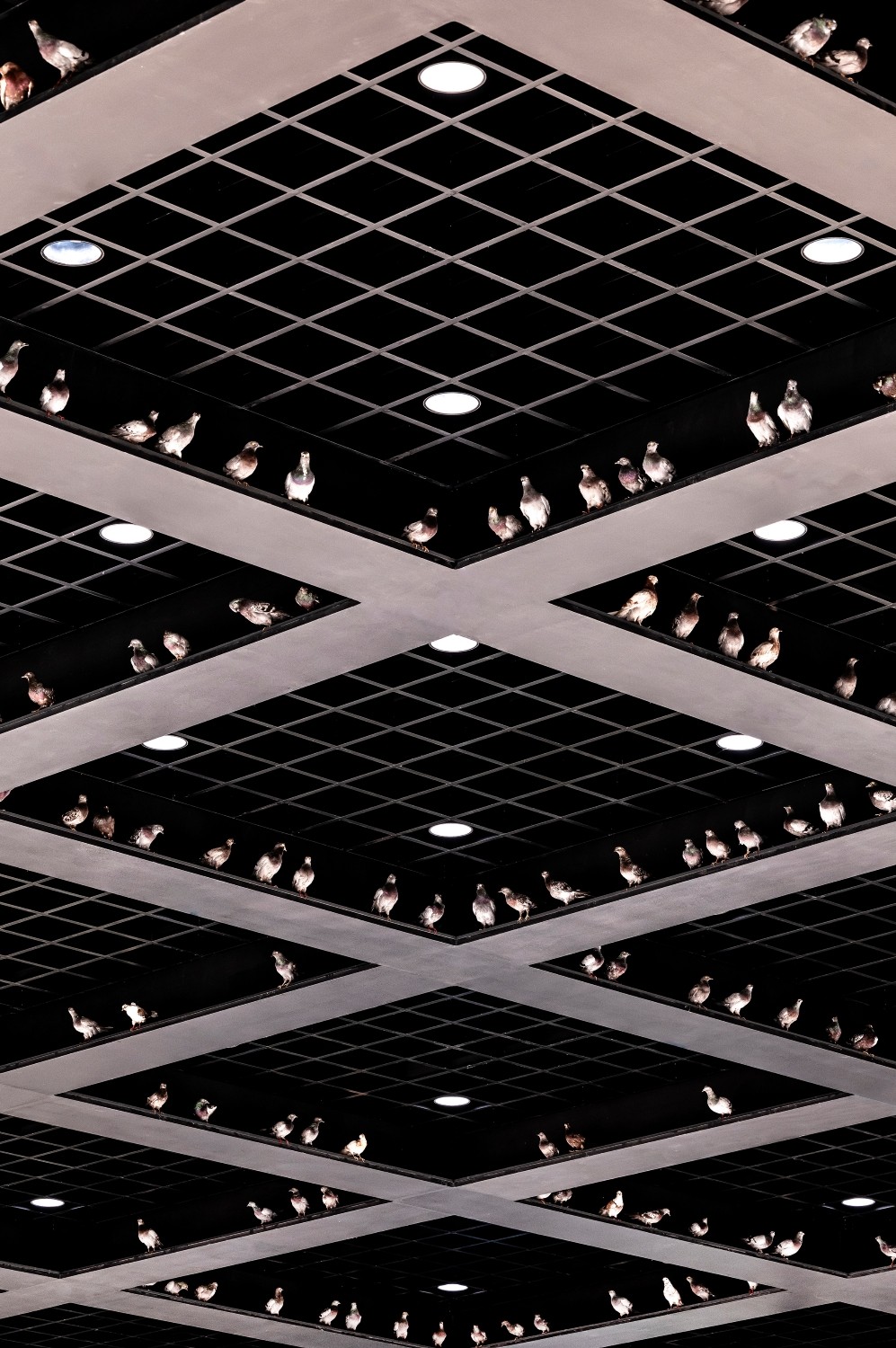
Above them, thousands of pigeons dried form “People” (2026), an installation which deals with the structure of the roof and radically changes the perception of space. The result is an environment that ranges from the solemn, the unsettling, and the unexpected, elements characteristic of the work of Cattelan.
New works for a single exposure
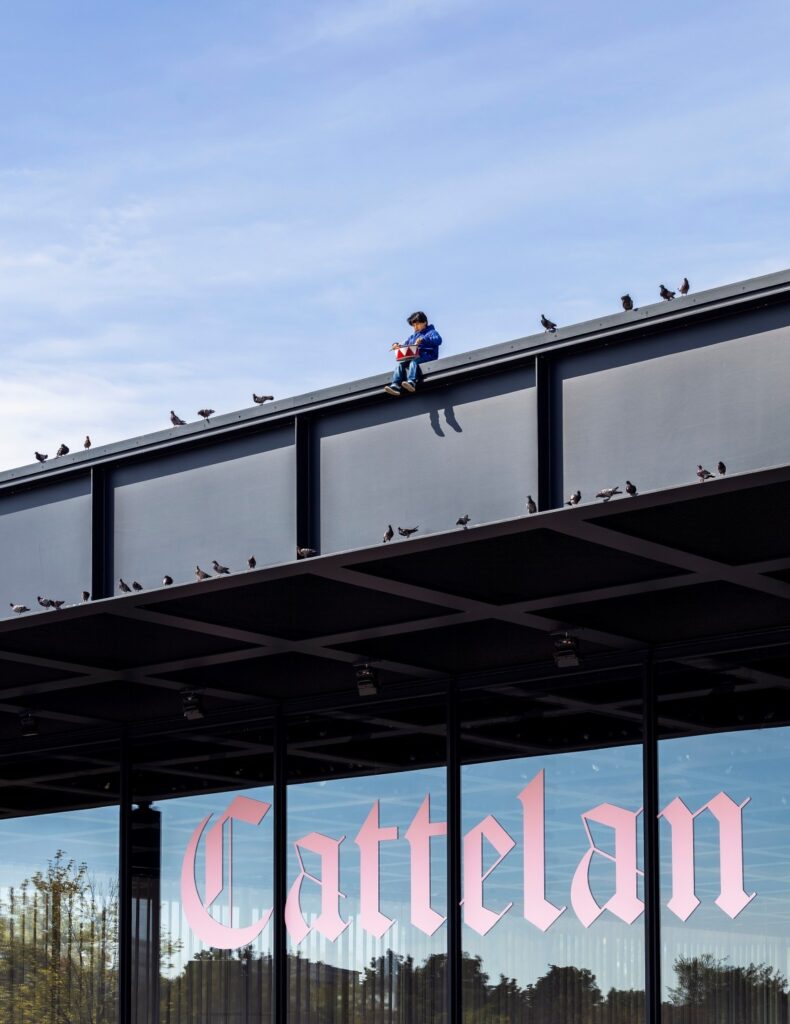
The proposal of Maurizio Cattelan NIGHT continues beyond the main room. On the roof of the Neue Nationalgalerie is “Never” (2003), a figure animatronics inspired by the protagonist of The tin drumthe published novel by Günter Grass in 1959.
The figure beats his drum at irregular intervals. The sound can remember a parade, an alarm, a funeral march, or even an attraction of the circus. Through this repetitive action, Cattelan poses as a reflection on the resistance, the political violence and the risk of forgetting to historical events.
On the terrace is also presented “Scar” (2026), a manhole cover cast iron that meets the titles of all the works included in the exhibition. The piece establishes a connection with the city and what remains hidden beneath its streets.
The concept of scar works here as a metaphor of the traces left by the events and the collective experiences. The work connects infrastructure, memory and history, by moving part of the exhibition from the interior of the museum into the urban space that surrounds it.
Two new facilities complete this reflection about time and death. “After” (2026) consists of an iron tube of six meters in length with a dog asleep in your interior. The tube is struck at regular intervals, creating a sound similar to a bell.
For its part, “Dust” (2026) transforms an everyday object into a container of memory. The installation uses a fire extinguisher that contains the ashes of a friend of the artist. An item normally associated with the emergency, the protection and the rescue takes on a completely different meaning.
BMW and Maurizio Cattelan, a relationship that began in 2016
The involvement of BMW in this exhibition also connects with a past collaboration with Maurizio Cattelan. The German manufacturer and the Italian artist agreed in 2016 during the Rencontres d’Arles, where Cattelan worked with the photographer Pierpaolo Ferrari in a project related to the BMW i3.
The result was known as “Spaghetti Car”, a conceptual proposal that covered fully electric vehicle with a motif inspired by spaghetti. The intervention used the car as an artistic medium to address, from the humor and provocation, concepts related to the consumption, the art and sustainability.
The relationship between Cattelan and BMW also dates back to 2006, when BMW was the first sponsor of the fourth Berlin Biennale, the Italian artist cocuró.
Now, twenty years after that participation in the art scene in berlin, Cattelan returns to the city with an exhibition of large-scale.
Award Nationalgalerie 2026, and the support of BMW
The Award Nationalgalerie was created in the year 2000 by the association FRIENDS of the Nationalgalerie and has established itself as one of the prizes that are more relevant to the contemporary art in Germany.
BMW continues its work as a member of the award since 2006. For the edition of 2026, the recognition starts a new stage to move to the iconic glass pavilion of the Neue Nationalgalerie.
The jury of this edition was made by Emma Lavigne, director of Collection Pinault Paris; Sam Keller, director of the Beyeler Foundation in Basel; and Klaus Biesenbach, director of the Neue Nationalgalerie.
The choice of Cattelan recognizes a career of more than three decades in which the artist has used sculptures, installations and interventions conceptual to question authority, the collective memory, and the relations of power.
His work has been presented in major international institutions, including the Solomon R. Guggenheim Museum of New York and the Monnaie de Paris, in addition to various editions of the Venice Biennale.
NIGHT will be in Berlin until march 2027
The exhibition Maurizio Cattelan NIGHT will officially open to the public on September 10, 2026 and will remain in the Neue Nationalgalerie up to the march 7, 2027.
The opening will take place on Wednesday, September 9 to 21:00 hours. During the Week of Art in Berlin, from 10 to 13 September, the hours will be from 10:00 to 22:00 hours.
The Neue Nationalgalerie is located in Potsdamer Straße 50, 10785 Berlin.
With NIGHT, Maurizio Cattelan uses one of the most recognizable buildings of modern architecture to build an experience that combines art, history, memory, and perception. The involvement of BMW in the Award Nationalgalerie returns to put in evidence the long-term relationship of the brand with the visual arts and with some of the leading cultural initiatives in Berlin.
More than an exhibition about dark, NIGHT raises a reflection on what happens when we have all of the answers. In the universe of Cattelan, the night does not represent an end point, but a transient state in which the certainties may change before it gets light.
Source: BMW Group