

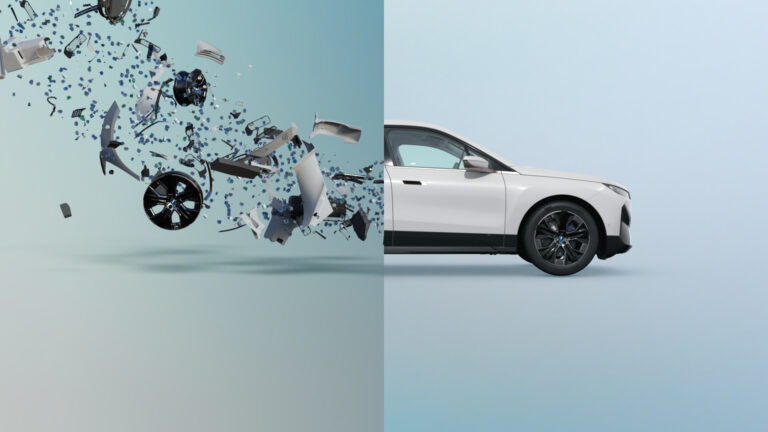
Munich. The recycling of vehicles is entering a new stage. For BMW Group, the goal is not only to recover materials of a car when it reaches the end of its useful life, but to get those same materials can return to the automotive industry with the quality required to be a part of new vehicles. The research project Car2Car just to demonstrate that this concept is technically feasible, and that, with an appropriate process of sorting and processing, you can achieve an industrial scale.
The results are especially relevant to materials such as steel, aluminum, and copper. Under conditions of extended processing and classification, the so-called “rate Car2Car” went from six to 51 per cent. This figure represents the percentage of materials from vehicles at the end of its life that, in principle, can be recovered with sufficient quality to be used again in industrial applications.
Beyond that percentage, the project raises a fundamental question for the future of mobility: what would happen if a car could become the raw material for the manufacture of another? BMW and its partners have demonstrated that an important part of that cycle can be a reality, although there are still challenges of technological, economic and regulatory before these processes can be applied in a widespread manner.
Recycling conventional to a true cycle of materials
For decades, the recycling of cars has focused primarily on recovering materials and prevent the vehicles at the end of its useful life end up as waste. However, to recover a material does not necessarily mean that it can again be used in applications of high value.
This is where the project Car2Car introduces an important difference. His aim was not to determine just how much material a vehicle could be recycled, but how much he could recover with a quality sufficient to return again to the chain of automotive production.
To study this possibility, BMW Group worked together with recycling companies, manufacturers of materials and academic institutions. The project examined different stages of the value chain, from the dismantling and crushing of the vehicles to the classification and processing of the materials obtained.
With methods currently common in the market, the project achieved a rate Car2Car of just six per cent considering the five groups of materials are analyzed. However, by incorporating engineering processes are more advanced, better pre-sorting, modifications in the crushing and separation systems more precise, the result increased to 51 percent.
The difference shows that the potential of recycling does not only depend on the material present in a car. It is also directly related to the available technology to separate and maintain their properties during the process.
The steel shows up where you can reach the recycling automotive
One of the most important results of Car2Car is located in the steel. This material represents a key part of any vehicle and, in principle, has great potential to be recycled. However, there are obstacles when looking to use again the scrap recovered in automotive applications and high quality.
One of the main problems is the presence of copper. This can come from the cables, connectors and various electrical components that are part of the modern vehicles. When copper is mixed with steel scrap for recycling, can affect the properties of the material and restrict its use for the manufacture of new steel plates intended for automotive applications.
The project Car2Car able to reduce this pollution by an additional step of sorting of scrap. In this way it was possible to obtain a raw material with a quality sufficient to produce flat steel destined again to the automotive industry.
The result would not be left solely in a laboratory test. BMW took the material to an industrial application in real after overcoming different quality tests. In the plant of the BMW Group in Leipzig there were over 100,000 pieces of production in series using this steel recovered, which were subsequently installed in new vehicles.
This point turns the project into something especially relevant. This is not only to demonstrate that a material can recover, but check that you can go back a string of industrial production and finish forming part of a car.
To further enhance the development of this technology, BMW has presented a patent application related to the process used to reduce the pollution by copper in the steel scrap.
Aluminum and copper also show a lot of potential
Although the steel was one of the great protagonists of the research, the results of the project were also significant for other metals.
Under standard conditions processing, the rate Car2Car for the steel stood at one percent. With the optimized routes of processing and classification, reached 81 percent. In the aluminum, the potential shifted from 23 to 52 percent, while that for copper increased from 48 to 68 percent.
These figures show that the metals present now some of the best opportunities to develop closed cycles of materials within the automotive industry.
The case of the aluminum is particularly interesting because of its growing importance in the manufacture of vehicles. Its low weight allows you to contribute to the energy efficiency and, in the case of the electric models, it can help to offset some of the additional weight associated with the batteries.
Recover aluminum from vehicles at the end of its useful life and reinstate you to new products can reduce the need to use virgin raw materials. The same principle applies to copper, a material more and more important due to the increase of electrical systems, electronics, and high-voltage inside of the car.
However, Car2Car also demonstrates that there is not a universal solution. Each material requires specific processes and different levels of investment to be able to return to demanding applications.
Plastic and glass represent the next big challenge
The results obtained with the metal contrast with the situation of materials such as plastics and glass. In these cases, the recovery of materials with the required properties for automotive applications continues to be considerably more complex.
Modern vehicles use a huge variety of plastics, many of them in combination with other materials or designed to meet specific functions. This diversity makes it difficult separation and classification once the car has been crushed.
The problem becomes even more complex when you consider that the recycled materials for a new vehicle must meet stringent requirements of quality, safety, durability, and behavior.
For this reason, BMW and the project partners believe that it will be necessary to develop processing chains specifically adapted to the different types of plastic. This will involve combining new technologies of classification with processing methods able to preserve the necessary properties for re-use in automotive applications.
The glass also presents similar challenges. Although there are processes of recycling statements, to retrieve a glass from the vehicle and return it to automotive applications of high-value required to overcome various barriers related to their composition, separation and quality.
The message of Car2Car, therefore, is not that all materials can be recycled in the same way. On the contrary: the project demonstrates that the circular economy needs different solutions for each type of material.
A string of recycling the need for new investments
For the results obtained by Car2Car can be converted into industrial practice is widespread, it is still necessary to develop additional infrastructure.
The first part of the process is located in the vehicle itself. A car designed from the start in their recycling can facilitate the dismantling and recovery of its materials. This philosophy is part of the focus of BMW named “Design for Circularity”, which seeks to incorporate criteria of the circular economy from the early stages of a product's development.
Then comes the process of disassembly, shredding, and sorting. Here will be required investments in new technologies capable of identifying materials with greater precision and to separate them efficiently.
Digitalization will also have an important role. Greater traceability of the materials could facilitate their classification, knowing their composition, and to ensure that they return to the right processes.
Finally, it will be necessary to create economic conditions that make it viable throughout the system. It is not enough that a technology works technically if the cost of retrieving, transporting, sorting and processing the materials is too high against the use of raw materials new.
For this reason, BMW believes that the development of these cycles materials will also depend on business models viable and regulatory frameworks capable of promoting the recovery of high-quality materials.
Car2Car points towards a new generation of vehicles circular
One of the most important aspects of the project is that its results are not limited to BMW. The information generated can become a reference for the development of the automotive industry in general.
The project brings together vehicle manufacturers, producers of steel, aluminum and copper recycling companies, technology providers and academic institutions. Among its participants were BMW AG, TU Bergakademie Freiberg, the Helmholtz Institute Freiberg, the Technical University of Munich, Scholz Recycling, STEINERT UniSort, thyssenkrupp Steel Europe, Salzgitter Mannesmann Forschung, Aurubis, Novelis Germany, OETINGER Aluminium and Pilkington Automotive Germany.
The collaboration along the entire value chain allowed us to identify where are the main opportunities and what are still obstacles that need to be resolved.
The results also have relevance to the evolution of the european regulations related to the vehicles at the end of its useful life. As you increase the requirements to recover materials, the industry will need to demonstrate not only that you can recycle cars, but you can do this while maintaining the quality needed to re-incorporate them into high-value products.
In this context, Car2Car offers a vision of what could become a new generation of circular economy automotive: vehicles designed from the beginning thinking about what will happen when they finished their useful life.
The project demonstrates that a car doesn't have to represent the end of a cycle of materials. Your steel, aluminum and copper may become again in resources to produce new components and, eventually, new vehicles.
The challenge now is to bring these results beyond the optimal conditions for research and turn them into processes scalable, competitive, and available on a large scale. BMW has already shown that the concept can work in a industrial chain real, with more than 100,000 parts manufactured from steel recovered.
The circular economy automaker still has a long way to go, especially in materials such as plastics and glass. However, Car2Car makes it clear that the future of the recycling of vehicles is not limited to reclaim materials: can be maintained within the industry for multiple generations.
In other words, the next BMW may contain part of the material history of a car that stopped pie years ago. And this possibility is one of the most interesting changes towards a mobility truly circular.
Source: BMW Group